
July is the month of AI posts. No disclaimers, no apology, just outright embracing the trend. After all, if you aren’t writing about AI or with AI, are you even writing at all? Every week this month, I will bring you both musings about an AI-enamoured (or disenamoured) world and practical tips on how to move forward in your personal AI journey, irrespective of where you are. So, let’s dive in.
There’s a second shift happening when it comes to AI.
After three and a half years of introduction, ever since ChatGPT first landed in November 2022 and rewired how most of us think about technology, the early adopters are ready to move to the next phase. The fence-sitters have jumped into the fray. And the naysayers are realizing they may not have an alternate route out of this.
The world has finally gotten around to accepting that AI is the next industrial revolution. And with that recognition, the billing has changed.
In the spring of 2026, both Anthropic and OpenAI quietly moved their enterprise customers from flat-fee subscriptions to token-based billing. The comfortable, all-you-can-eat buffet became a per-item menu. OpenAI dropped its ChatGPT Business seat price to $20 and switched to pay-as-you-go token consumption. Anthropic shifted Claude Enterprise from fixed per-user pricing (up to $200/month) to a similar model: a low seat fee plus usage-based charges on top. GitHub Copilot followed suit in June, moving all its tiers to token-based credits.
Overnight, what had been buried inside a flat subscription became visible, line-item-by-line-item, on a finance team’s spreadsheet. And CFOs have started asking for a return on investment for all those tokens consumed.
Let’s face it. AI is not cheap.
per employee/month
companies
“AI-pilled” firms
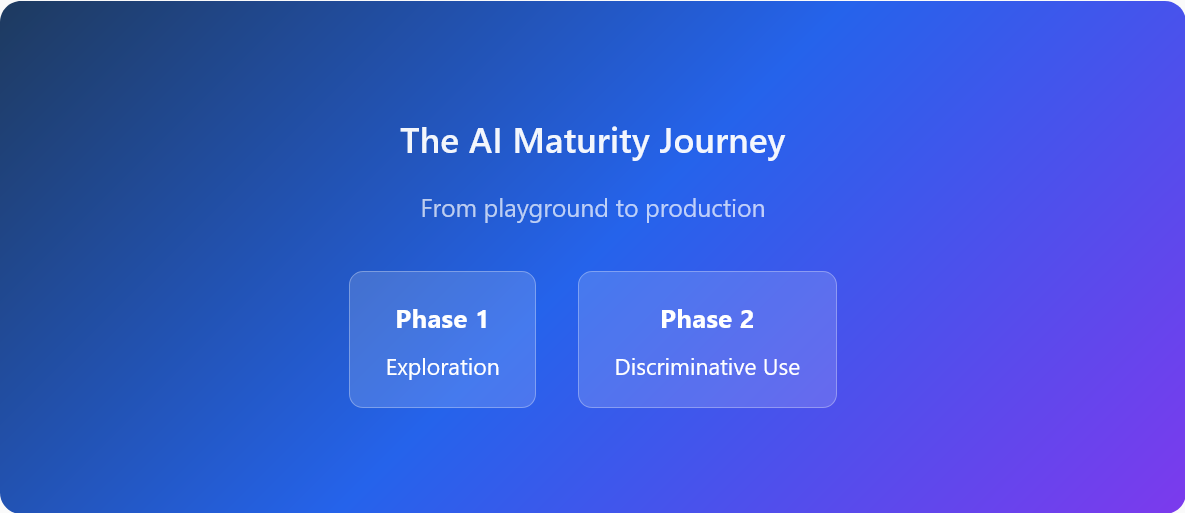
Phase 1: The Playground
Depending on a company’s budget, Phase 1 looked different across organizations, but the spirit was the same. Employees received a variety of free or generously subsidized token usage. It was a phase of exploration where everyone could do whatever they wanted.
And they did.
Overnight, apps flooded the internet. Everything from recipe generators to trip planners to “build your own personal brand strategist.” Everyone was a wannabe developer. If you could write a prompt, you could ship a product. The barriers to creation fell so low that they practically disappeared.
It got to the extent that Merriam-Webster named “slop” its 2025 Word of the Year, defining it as “digital content of low quality that is produced usually in quantity by means of artificial intelligence.” Not surprising. When creation becomes effortless, curation becomes the bottleneck.
When creation becomes effortless, curation becomes the bottleneck.
Eventually, the novelty faded. People discovered ways to turbocharge their individual productivity. Summarize that 40-page document in seconds. Draft that email in the time it takes to think the first sentence. Analyze that dataset without opening Excel. Companies enthusiastically tracked adoption. Maximum token users were given appreciation and awards. “AI Champions” became a real title in org charts. Usage dashboards (ironic, I know) were built to show leadership just how much everyone was embracing the future.
Phase 1 was fun. Phase 1 felt like progress.
And then came two realizations.
Realization #1: Individual Productivity ≠ Organizational Productivity
When individual productivity multiplies through AI, does team and organizational productivity automatically go up?
Your instinct says no. And the reasoning supports it.
More individual output means more artifacts to reconcile, more proposals to evaluate, more pull requests to review. The bottleneck moves from creation to integration and decision-making.
Each AI-armed person explores more solution space independently, arriving at sync points with more divergent ideas. Alignment takes longer when everyone shows up with a fully baked proposal.
Higher throughput can mask strategic misalignment. Everything looks productive, but if vectors aren’t pointing in the same direction, you get more waste at higher velocity. Activity is not progress.
Prioritization, stakeholder buy-in, ethical review, customer empathy checks; these don’t speed up just because inputs arrive faster.
The longer individuals and organizations stayed in Phase 1, the messier the environment got. Great, everyone knows how to use it. What next?
If you want group productivity gains from AI, do you redesign the work, or just the tools?
The implication is clear. The organizations that win Phase 2 will treat AI as a workflow architecture problem, not just an individual toolkit problem. Giving everyone a hammer doesn’t build a house. You need a blueprint, a sequence, and someone thinking about how the pieces fit together.
Realization #2: The Bill Always Comes
With adoption and reliance came visibility. And with visibility came accountability.
The Forbes headline from June says it plainly: “Token Billing Exposes AI’s Missing ROI And Puts Billion-Dollar Bets At Risk.” Uber burned through its entire 2026 AI coding tools budget by April after rolling out tools at near-total scale. Their COO acknowledged that despite 95% of engineers using AI monthly, he could not draw a line between that spend and meaningful product improvements. Microsoft, facing Claude Code bills of $500 to $2,000 per engineer per month, began cancelling direct licenses and routing engineers back to cheaper alternatives.
According to Ramp’s AI Index, the median US firm now spends $11.38 per employee per month on AI. The top 10 percent spend $611. The top 1 percent, the cohort Ramp calls “AI-pilled,” spends roughly $7,500 per employee per month. Token prices dropped over 90% since 2023, yet total corporate AI spending doubled since late 2025. Classic Jevons’ Paradox in action.
The conversation shifted from tracking utilization to demanding effective utilization. Not “how many people are using it” but “what are they producing with it, and is it worth what we’re paying?”
The companies that pull ahead will not be those with the smallest or largest AI bill. They will be the ones that produce the highest Return on AI.
— BCG, “What CEOs Need to Know About the True Cost of AI” (July 2026)
Welcome to Phase 2
All of this ushers us into Phase 2.
I know that as I say this, AI is also a great divider. Not all organizations had the finances to let their employees play freely in Phase 1. The truth also is that the world doesn’t wait for everyone to catch up. Phase 2 is here, whether we like it or not.
It is the phase of discriminative use of AI.
The questions get harder. How are you using AI to enable teams and the organization as a whole, not just individuals? How does your use case compound rather than fragment? What’s your AI strategy beyond “give everyone access and see what happens?”
Your time to play is up. Your time to produce is here.
Phase 2 demands intentionality. It asks organizations to move from “let a thousand flowers bloom” to “which flowers are we actually going to water?” It asks individuals to move from “look what I can do with AI” to “here’s the measurable value AI created that wouldn’t have existed without it.”
If you built an app in Phase 1, Phase 2 asks: how is your tool better than the 30 others out there doing the same thing? If you’re using AI to write faster, Phase 2 asks: is the writing actually better, or just more? If your team adopted AI for code generation, Phase 2 asks: are you shipping more, or are you just creating more code to review?
The shift is uncomfortable. Phase 1 was permission to experiment. Phase 2 is accountability for results.
So What Does This Mean for You?
Whether you’re an HR professional thinking about how to guide your organization through this, a leader managing a budget that now has a very visible AI line item, or an individual contributor trying to stay relevant, here’s what Phase 2 looks like:
For organizations: Stop measuring adoption. Start measuring impact. Build the governance to distinguish between AI usage that compounds organizational capability and AI usage that just keeps individuals busy. The metric isn’t tokens consumed; it’s value created per token.
For teams: Solve the coordination problem. If AI makes everyone faster at producing, invest in the infrastructure to integrate faster too. The team that figures out how to converge quickly after diverging with AI wins.
For individuals: Specialize. The generalist “I use AI for everything” phase is over. The value now lies in knowing when AI helps, when it doesn’t, and how to use it in ways that create outcomes others can’t replicate with the same tools.
If Phase 1 was the free trial, Phase 2 is the subscription renewal. And this one doesn’t come with an all-you-can-eat option.


2 thoughts on “The AI Maturity Model: What Does Phase 2 Look Like?”