
Still the month of AI posts. Last week I wrote about the shift into Phase 2, the phase where we stop playing and start producing. This week is about the harder, quieter work underneath that shift. Not adopting AI. Unlearning. Pulling out every belief we built our careers on, laying it on the table, and asking whether it still deserves to be there. So, let’s dive in.
A few weeks ago, I wrote a post arguing that dashboards are dead. I won’t rehash the case here. Go read it if you missed it. Here’s the short version: agents don’t need a dashboard to connect the dots across scattered systems, so increasingly, neither do we.
I still believe that. In fact, I think we are about twelve months away from it being obviously true. As agents get better and we settle into a rhythm of handing them tasks we used to hold ourselves, one small graduation at a time, the dashboard will quietly stop being the thing we reach for first or ever.
Two things could slow that down. The first is trust: whether we believe the agent enough to hand it the work. That is a real conversation and worth its own post. The second is quieter and, I think, more dangerous, because it hides inside us. It is our own unwillingness to let go of habits that have served us well. And that is what this post is about.
Being AI-native is not about the tools you adopt. It is about the beliefs you are willing to retire.
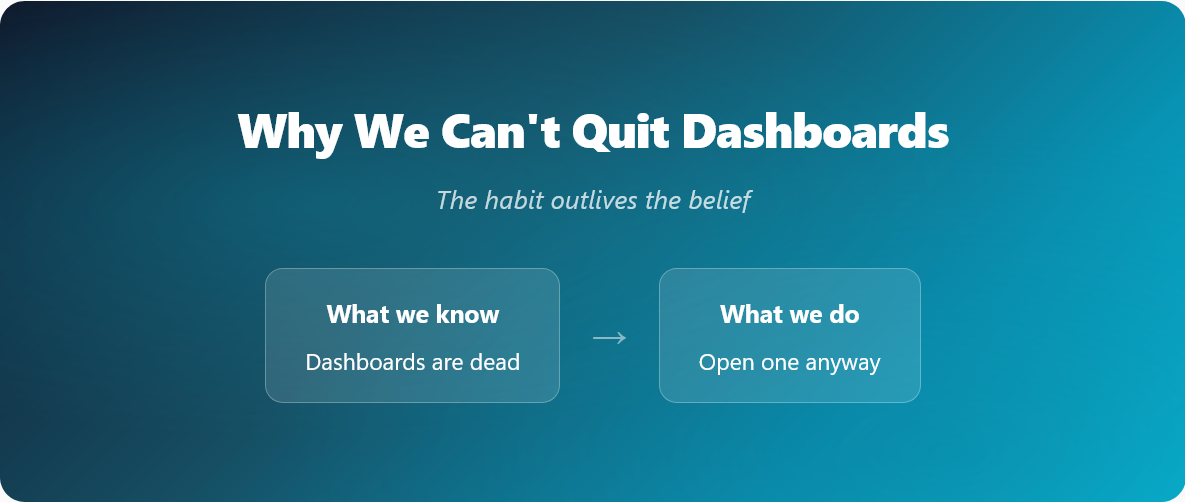
Here is my confession. I wrote the post declaring dashboards dead, and I still open one every single morning. I know the single pane of glass is a workaround, not a solution. I made the argument, nodded along to my own logic, and still went looking for the comfort blanket the next day.
That gap, between what I know and what I reach for, is the whole game. It is easy to buy a new tool. It is much harder to give up an old assumption, especially one that has worked for you for a decade. If we truly want to be AI-native, this is the fundamental shift we have to embrace. And dashboards are the simplest, most stubborn place to illustrate it.
Why the habit is so hard to break
The old post made the case for why dashboards are on their way out. What it didn’t answer is why, knowing all that, we still can’t put them down.
The answer is that the reluctance is not rational. It is emotional. A dashboard gives us a feeling of control, a sense that we are watching, that nothing is slipping past us. Letting go feels like taking our hands off the wheel, even when the car has learned to drive. So we keep rebuilding the thing we said was dead, dressing it in better technology, making it look prettier, cramming more data and visuals into it, telling ourselves this version will finally be the one. The habit outlives the belief. That is exactly the trap being AI-native asks us to climb out of.
A mirror worth borrowing
If you want to see where this goes, it helps to look at a world that is a few steps ahead of us: the people who build monitoring for cloud systems. I use this analogy because this is the world I live and breathe in every working day.
They are living through the same reckoning with dashboards that HR is about to have, and they are further down the road. Their language is different, but the story is ours.
Their first realization is that observability is shifting from human-centric dashboards to something meant to be consumed by an agent, not read by a person. For years they built beautiful views for engineers to stare at. Now they are asking a stranger question: what if the first thing to read this data isn’t a human at all?
Translate that into our world. We build attrition dashboards, engagement dashboards, hiring-funnel dashboards, all of them designed for a person to read and interpret. What happens when the first consumer of your attrition data is an agent that has already read it, connected it to your headcount plan, and drafted the “here’s what’s happening and why” before you have opened anything?
Their second realization is that the surface is no longer where the work happens. Developers stopped going to a console to check on things. The monitoring moved to them, embedded as a live stream inside the environment where they already work, rather than a destination they have to visit.
The number should arrive in the room where the decision is being made.
The HR parallel writes itself. The work does not happen in the reporting portal. It happens in the one-on-one, in the calibration meeting, in the Slack thread where a manager is quietly deciding whether to fight for a counteroffer. Dragging people to a dashboard to find the number is backwards. The number should arrive in the room where the decision is being made.
Their third realization is the one that stings the most. They have largely stopped asking customers to build their own alarms and dashboards from scratch. Instead, the system surfaces the anomaly on its own, explains the likely root cause, and recommends what to do about it, straight out of the box, and then moves to, wait for it, self-healing. Visibility that goes looking for problems, rather than a static wall of charts waiting to be interpreted.
This is where HR is furthest behind. Most of our data work stops at “here is a chart showing attrition is up.” We rarely get to “here is why it is up,” almost never to “here is what I would do about it.” We hand people the raw view and leave the hardest part, the interpretation, entirely to them. We built a dashboard and called it insight.
The ladder we are only halfway up
There is a natural progression hiding in all of this, and it is worth naming the rungs.
The dashboard. Shows you what is happening.
human does the most
Tells you when something crosses a line.
Tells you why it happened.
Tells you what to do about it.
Does it for you. “Self-healing.”
human drops out
Observe is the dashboard: it shows you what is happening. Alert tells you when something crosses a line. Explain tells you why. Recommend tells you what to do. Act does it for you. That last rung is where the cloud world is headed, and where the word self-healing comes from: closed-loop remediation, where the system detects a problem, diagnoses it, and resolves it on its own, for common and well-understood issues, without a human in the loop at all.
Most of HR lives on the first rung. A few of us have reached alert. Explain and recommend are where the real value is, and where we spend the least time. Each step up, the human does less staring and interpreting and more actual deciding. That is not a downgrade of the human role. It is a promotion. We stop being the interpreter of charts and start being the one who decides what to do with a conclusion someone, or something, has already reached.
And then there is that top rung, the uncomfortable one. Picture what it could look like in our world. An agent notices a high performer’s engagement dipping, their after-hours activity creeping up, and their one-on-ones quietly thinning out. It does not wait for you to open a dashboard and connect those dots. It flags the flight risk, explains the likely why, drafts a retention conversation for the manager, and pings you with a recommended comp review already teed up. By the time it reaches you, the first move has been made. You still decide, but the noticing and the groundwork happened without anyone staring at a chart.
I will admit I find the idea seductive. Something that notices a problem and quietly starts fixing it before anyone has to raise it. But I want to be careful here, because HR is not cloud infrastructure. The whole point of that top rung is that humans drop out of the loop. That is a wonderful thing when the issue is a misconfigured server. It is a very different thing when the issue is a person. The line between “helpfully resolved before it became a crisis” and “a decision about a human being made with no human in the room” is thinner than the word self-healing makes it sound. I do not think the answer is to refuse the ladder. I think the answer is to be very deliberate about which rungs we are willing to hand over, and which ones must keep a human standing on them. That deliberation is exactly the kind of belief-examination Phase 2 demands.
The line between “helpfully resolved before it became a crisis” and “a decision about a human made with no human in the room” is thinner than the word self-healing makes it sound.
What clinging to the dashboard actually costs
It is tempting to treat all of this as a preference. Some people like dashboards, some don’t, no harm done. But staying on the bottom rung is not free. Every hour spent building and reading a view is an hour not spent on the judgment only you can bring, and while you stitch that view together, the business has already moved on without you. The cost of the habit is not the dashboard. It is the relevance you quietly trade away by staying one rung too low.
So, what do you actually do about it
I promised this series would not just diagnose. So here are three things you can try this week, none of which require new tools.
Take one recurring report you produce and place it honestly on the ladder. Does it sit at observe? Naming that is the start.
Pick one decision moment that matters, a calibration, a counteroffer, a promotion case, and ask what single piece of information should arrive there unbidden. The number should find the person, not the other way around.
And name one belief you will consciously test this quarter. Mine is “I need to see it to trust it.” Every time my agent hands me a number, I go back to the dashboard to check it. It is right 99% of the time, and still I check. That is the belief I must retire, on purpose, rather than waiting for it to fall away on its own.
A quieter question I keep circling
I will end somewhere more personal, because it is the thought I cannot put down. If agents are increasingly the ones consuming the data and drawing the conclusions, then who am I writing this blog for? If the first reader is now a machine that briefs the human, does more of my work quietly shift from “make this clear to a person” to “make this clear to a machine that will make it clear to a person?” I do not have a clean answer.
What I am sure of is smaller and closer to home. Being AI-native was never going to be about the tools. It was always going to be about the beliefs we are brave enough to retire. For now, I will keep opening my dashboard in the morning. But I am starting to ask, each time, whether I am doing it because I need to, or just because I always have. And the day I stop opening it will not be the day a better tool arrives. It will be the day I finally let the belief go. But will I ever let go of writing for humans on this blog? I doubt it. Maybe I’ll just make it a tad bit friendlier for agents to digest. And stop at that.


2 thoughts on “Why We Can’t Quit Dashboards (And What It Says About Going AI-Native)”