A recent conversation with a colleague pushed me to think hard about AI, data and what we build next. But before we could get to the future, we kept circling back to one question: do I trust what my agents are telling me?
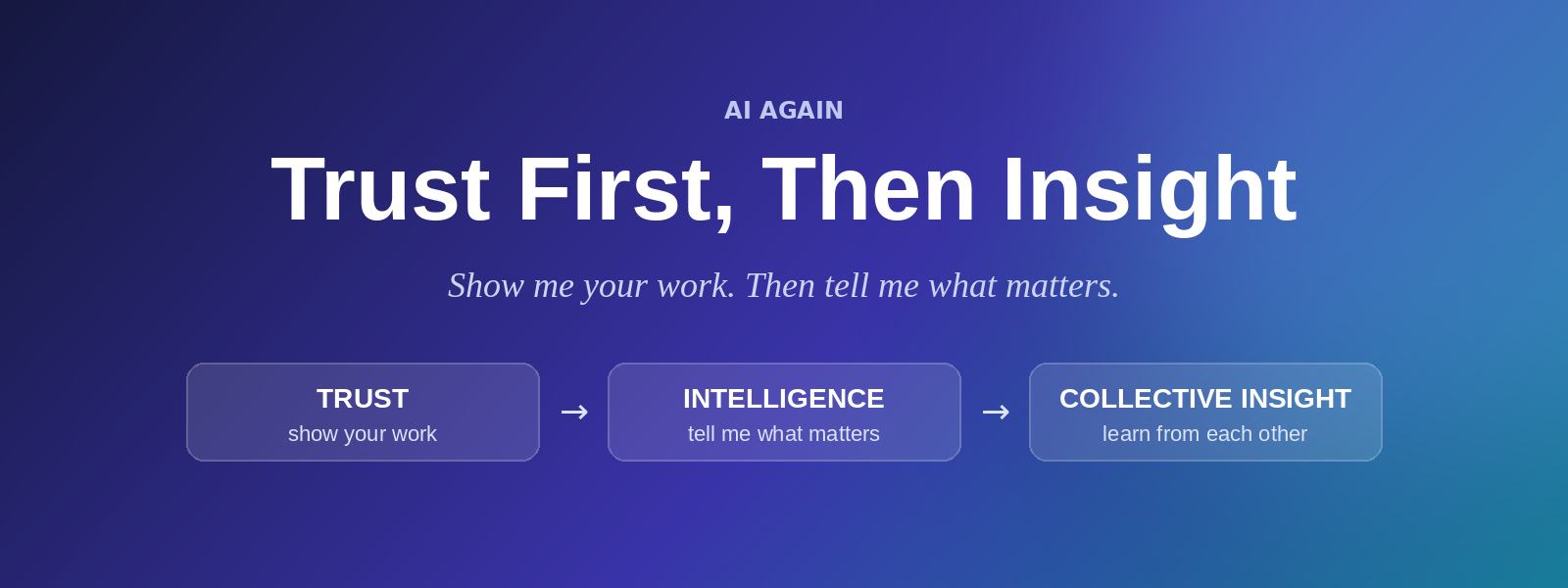
It’s a fair question. One bad number in a leadership review doesn’t just hurt the deck. It hurts the decision it drives. That question became the first of three themes from our conversation, and each one builds on the last: trust, then intelligence, and finally collective insight.
Let’s start with the linchpin: trust.
Trust: Show your work
One idea from the conversation stuck: safety is a property of the system; trust is a property of the relationship. A system can work perfectly and still not be trusted, because nobody can see inside it.
I’ve been using AI to build monthly people reviews (MBRs). Early drafts looked right: well formatted, confident, easy to read. That was the problem. Confident isn’t the same as correct, and I couldn’t tell which numbers had a solid source and which were the model filling a gap.
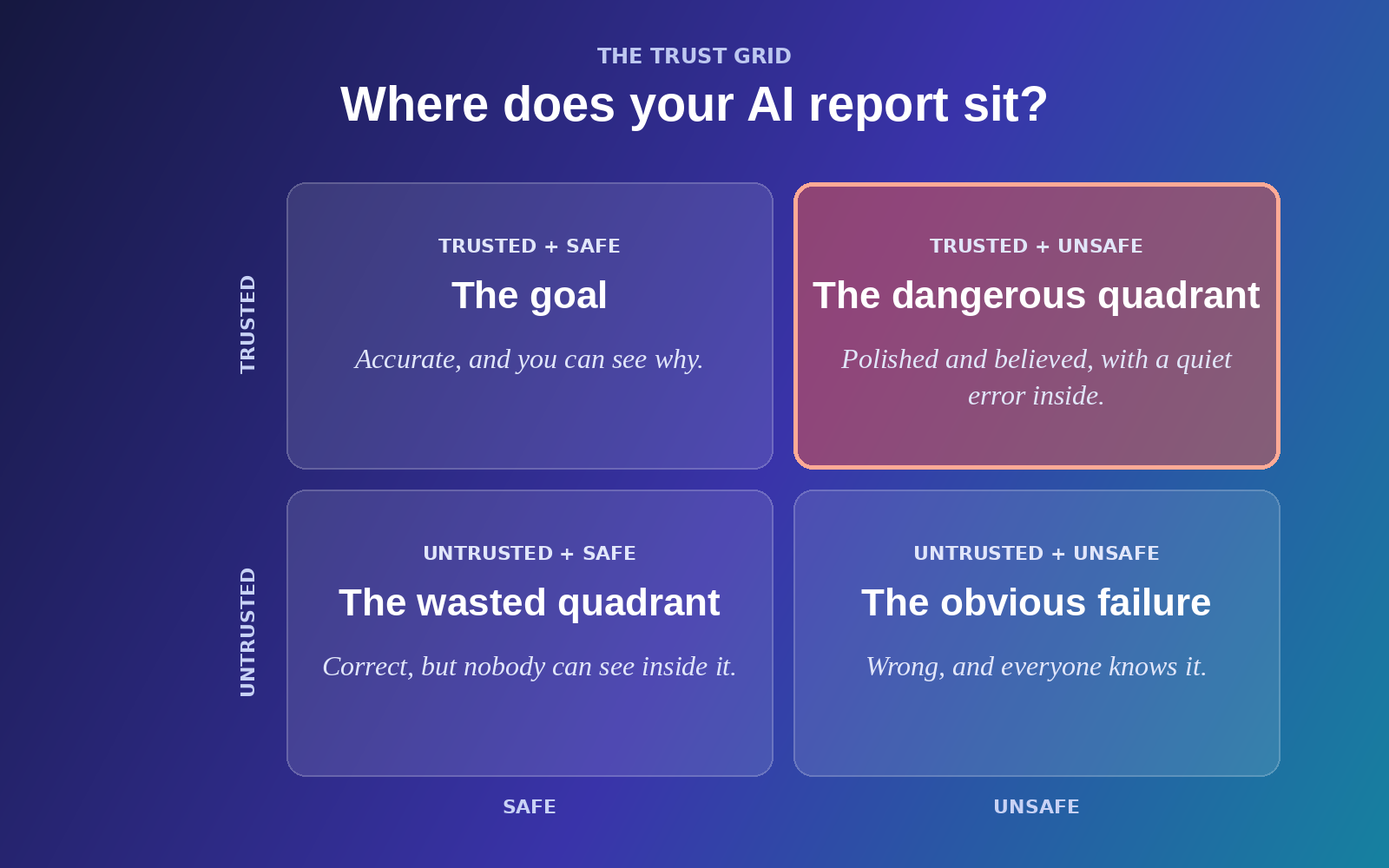
Picture a simple grid: safe or unsafe, trusted or untrusted. The dangerous corner is trusted but unsafe, where a good reputation hides a bad system. A polished AI report with a quiet error sits right there. It’s riskier than a rough draft, because nobody thinks to question it.
Three habits got me out of that corner.
Every section names its source. Each section of the MBR says where its data came from: which dashboard, which report, which date. If I’m curious, I know exactly where to check. The AI isn’t asking me to take its word for it.
Every report explains its math. Not every number comes straight off a dashboard. A trailing twelve-month attrition rate, a ratio, a change since last quarter: these are calculated. So each report has a Metrics Definitions section that shows what was counted, what it was divided by, and over what period. Small choices matter. Dividing by today’s headcount instead of the average over the year can noticeably inflate an attrition rate. If I want to recalculate a number myself, I know exactly how.
Every report ends with a Metrics Transparency box. It lists every metric that wasn’t shown, and why: suppressed for privacy, source unavailable, not applicable. If nothing was left out, it says so: “All metrics displayed. No omissions.” The risk with AI isn’t just a wrong number. It’s a missing number you never knew was missing.
Once you’ve worked this way, it’s hard to go back. I now ask three questions of every generated report I see, whether I built it or not:
Where did this number come from? How was it calculated? What was left out? If a report can’t answer all three, I don’t trust it, no matter how polished it looks.
We don’t trust AI because it’s smart (or even correct). We trust it when it’s accountable.
Intelligence: Not another dashboard
I showed my colleague one of those MBRs as an example of where I think HR reporting is heading. The pushback was immediate: isn’t an MBR just another dashboard?
To some extent, yes. I’ve argued before that dashboards are a workaround, yet we still like our charts and numbers, and letting go of them takes time. What has changed is how I use the report. When I walk into a room, I don’t walk through the charts. I steer the conversation to two places: the findings in the executive summary at the top, and the discussion questions at the bottom. The metrics sit collapsed in between, for anyone who wants to check the evidence.
The test: over time, do the metrics stay collapsed, and do we get through the whole meeting without ever opening them?
If we do, the MBR has become a conversation, and the numbers are the evidence, not the agenda. But even that isn’t the end goal. AI with all the data should be able to answer questions like these:
Is this org healthy? A straight answer, with the evidence behind it.
What should I pay attention to? Not twenty charts. The three things that matter this month.
What are my priorities, and am I on track? It should ask, remember them, and measure against them.
And most importantly – Are my interventions working? We launch a manager development program or a retention push, then wait, and often never properly close the loop. I want a system that tracks the interventions and whether they have meaningfully impacted the metrics. I want something that comes back with one of two answers:
👍 Your interventions are working. Here are the numbers that prove it.
✋ Stop. This isn’t working. Here’s what’s telling us, and what to try instead.
I don’t expect to hand all of this over on day one. We give a system more autonomy as evidence builds, rather than approving everything by hand forever. For HR, that’s a ladder. First the AI reports the numbers and I check its sources and math. With a track record, I trust it to flag what matters. Eventually, I trust it to tell me when to stop. A report tells you what happened. Intelligence tells you what it means.
Collective insight: Learning from each other
Everything so far is about one HRBP and one org. But every HR person is running experiments in their own corner, and almost none of it travels.
Picture this. One HRBP pilots monthly skip-level conversations for new managers and sees early-tenure attrition on those teams start to fall. Two doors away, another HRBP is staring at the same problem and about to design something from scratch. Neither knows the other exists. The result lives in a doc, a hallway conversation, someone’s memory.
Now imagine every priority and experiment stored centrally, with its outcomes. The system could tell me:
Here are the strengths you could build on. You’re already doing well here, so a small push pays off.
Here are the red and amber metrics to address. This is where the risk is.
Here’s what other HRBPs tried on the same problem, and what happened.
Want to try it? Let’s set it up and track it from day one.
That’s not a tool. That’s a team that learns together.
If it’s this valuable, why doesn’t it happen already? Not because HRBPs don’t want to share. It’s because our knowledge-sharing mechanisms are complicated. Write it up, find the right repository, tag it properly, hope someone searches for it, then hope they find it. Most of us give up somewhere along the way. This is where AI changes the game. Layer AI over a knowledge repository and it gets much easier: it can capture an experiment as you run it, connect it to the right metrics, and surface it to the HRBP who needs it, at the moment they need it. What used to be gnarly becomes easy.
Where this leaves us
What makes us trust AI-generated recommendations? The same things that make us trust people: show your sources, show your math, admit what you don’t know, and say so when something isn’t working.
And what should a central solution become? Not a better place to look at data, but a partner that knows our priorities, tells us whether we’re winning, and connects us to what everyone else has learned.
So I’ll end with a question for you: what would it take for you to trust an AI recommendation in your next review? Tell me in the comments.