
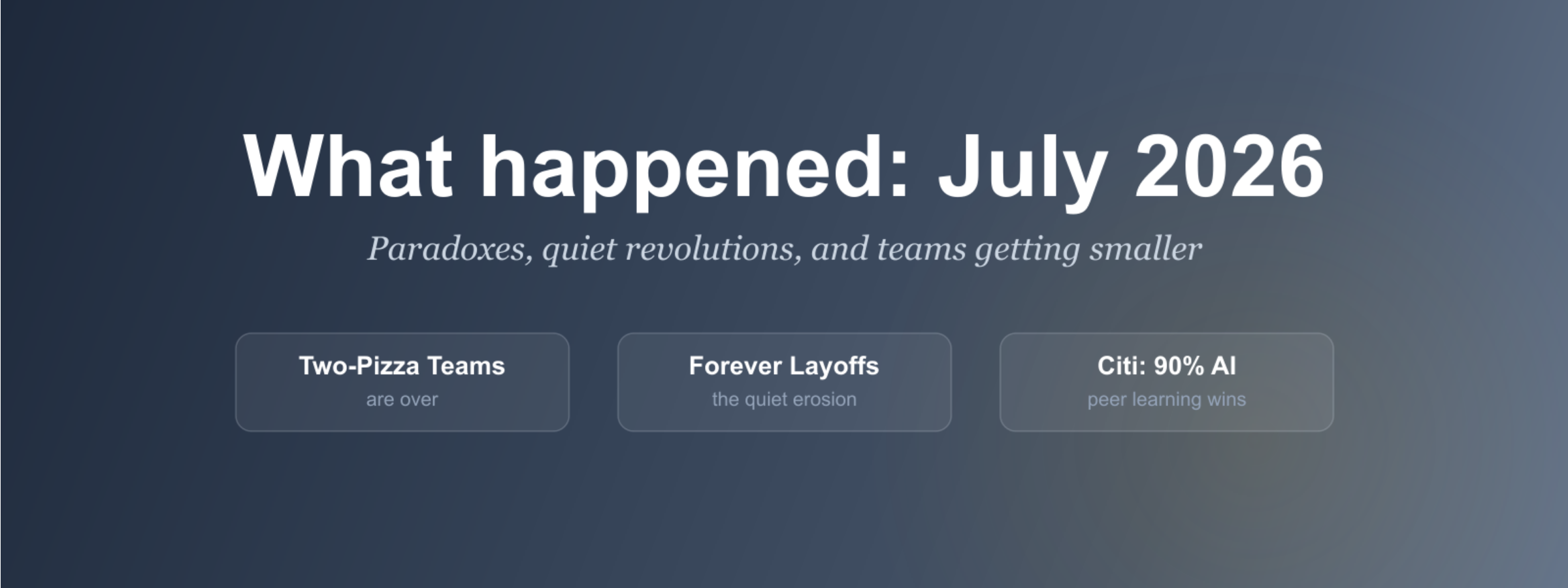
July arrived with bright sunshine and strange paradoxes. The labour market is posting more jobs than ever, yet layoffs are everywhere. Companies are reaching record AI adoption, but fewer than a quarter feel their people are ready. And just as we all settled into the idea that small teams are the way, someone decided they should be even smaller. The world of work in July 2026 is a study in contradictions.
So, without further rambling, let’s jump straight into our top three stories from the month of July.
“Two-Pizza Teams Are Over”
Business Insider reported (July 19) a growing consensus among tech leaders that AI-assisted engineering has made Jeff Bezos’s famous “two-pizza rule” (teams of fewer than 10) too generous. David Pan, Cursor’s field CTO and a former Amazon engineering manager, put it bluntly on X: “He was right about small teams. But in the AI era, two pizzas are too much pizza.” He’s not alone. Instagram CEO Adam Mosseri said his division made “a very big shift.” Before AI, the average team was roughly “a baker’s dozen.” Now Instagram runs pods of “four to six engineers who are a bit more generalists,” plus a product person and a specialist. Coinbase’s Brian Armstrong is experimenting with “one person teams” where engineers, designers, and PMs are all one role, “concentrating around AI-native talent who can manage fleets of agents.”
The new magic number, it seems, is five to seven. Not counting the agents, who don’t eat pizza. This one has been buzzing around in my head all month. For twenty years, two-pizza teams have been gospel in tech. Now we are watching that heuristic get revised downward in real time. And it’s not just tech with hot takes. Jamie Dimon said teams should operate “like Navy SEALs or the Army’s Delta Force.” Wix’s CEO called it “the most significant shift in how companies are built since the invention of modern programming languages in the 1970s.” If the optimal team size shrinks, the implications cascade: fewer managers, different spans of control, rethought career ladders, and entirely new approaches to org design. It’s time we start doing workforce planning differently all over again.
In the AI era, two pizzas are too much pizza. The new magic number is five to seven. Not counting the agents, who don’t eat pizza.
The “Forever Layoff” Era
At the end of 2025, Glassdoor coined a phrase that stuck: the “forever layoff” era. Not massive single cuts that make headlines, but small, continuous reductions that sustain a baseline level of anxiety without ever triggering the kind of outcry that forces a response. The data shows the layoffs are continuing. According to TrueUp, there have been 457 layoffs at tech companies so far in 2026, impacting 167,194 people, at a pace of 853 per day. That is ahead of the full-year 2025 total of 245,953. AI-related layoffs alone reached 128,000 by July 1, already higher than all of 2025.
Employees feel leaders prioritize efficiency over stability, while leaders cite economic pressures and AI investments. Remaining staff absorb heavier workloads. The constant drip is doing something corrosive to culture and engagement that aggregate statistics completely miss. People see job postings but also see the freezes, the restructures, the roles that stay open for months and then quietly disappear. The question nobody is answering well: in an era of near-zero psychological safety, how do managers keep their teams motivated? The old playbook assumed a baseline of stability. You could push people to stretch because they trusted the ground wouldn’t disappear beneath them. That contract is broken now. Every restructure tells your team that doing good work is not insurance against being cut. So what do you do? You cannot promise stability you don’t control. You cannot pretend the cuts aren’t happening. And you cannot motivate people with purpose when they’re spending half their cognitive energy scanning for the next threat. There is no clean answer here. But the first step is honesty: stop pretending morale is a comms problem. It’s a trust problem. And trust, once broken at the institutional level, gets rebuilt only at the human level, one manager at a time, one honest conversation at a time. That’s slow, expensive, unglamorous work. It doesn’t fit in a slide deck. But it is the work.
If people live in perpetual anticipation of the next “restructuring,” we’ve lost something that no retention bonus can buy back.
Citi’s Peer-Learning AI Playbook
A Wall Street bank. That number made me do a double-take.
How did they get there? Not through mandates or surveillance. They ran an HR-specific hackathon in May with 180 people pros across 35 teams building AI solutions for actual people processes, and deployed a 4,000-person peer-to-peer training model. People taught people. Adoption followed naturally.
I love everything about this story. Where “AI adoption” usually means executive memos and mandatory LMS modules that nobody completes, Citi bet on curiosity and social proof. The hackathon didn’t just teach skills; it created advocates. The peer trainers weren’t IT people parachuting in; they were colleagues who sat in the same meetings. If you’re struggling with AI adoption in your org (and let’s be honest, most of us are), this is the playbook worth studying. Trust beats surveillance, every time.
Trust beats surveillance, every time.
Three other things you should know
California and Canada enforce 4-day RTO mandates. Two of the largest public-sector return-to-office mandates yet took effect in early July. California’s state employees returned to 4-day in-office schedules on July 1, up from 2 days, sparking protests. Canada’s federal public servants moved to 4 days per week on July 6, with some departments still lacking adequate space. Both face pushback over office readiness, commute burdens, and whether productivity actually improves. Private-sector employers are watching these closely to calibrate their own policies.
Netflix declares “AI fluency” a universal expectation. Netflix CPTO Elizabeth Stone said on Lenny’s Podcast that every employee, from new hires to senior execs, is expected to develop “AI fluency” regardless of role. She defines fluency as three things: an experimentation mindset, judgment about where AI helps versus doesn’t, and demonstrated ability to build with tools. This isn’t about being technical. It’s about being curious, competent, and willing to experiment. Netflix is treating AI comfort as a cultural overlay, not a specialist function.
81% of organizations still committed to inclusion. A Catalyst/Meltzer survey of 2,200+ employees and leaders finds that 81% of organizations say they remain committed to inclusive culture. Among non-federal-contractor companies, 52% have actually increased their inclusion practices over the past three years. However, among federal contractors, 51% have decreased efforts under regulatory pressure. Meanwhile, the EEOC voted to rescind its 40-year-old affirmative action guidance and proposed ending the 60-year-old EEO-1 demographic data collection requirement. The picture: DEI is evolving and relabeling, not disappearing, but the regulatory ground beneath it is shifting fast.
So that was July. A month of paradoxes. Teams are getting smaller. Layoffs are getting quieter. Adoption is happening through peers, not policies. And inclusion continues, even as the regulatory scaffolding around it gets dismantled piece by piece.
AI continues to dominate these monthly roundups, though this month the stories felt less about the technology itself and more about what it’s doing to the structures around it: team size, job definitions, performance expectations, adoption strategies. The technology is no longer the headline. The organisational response is. That feels like progress.
Forever Layoffs
Citi: 90% AI
RTO Mandates
Netflix AI Fluency
DEI Developments
What would you pick?
Let me know your top stories from the month. Drop them in the comments, and I promise I’ll look them up.


